Email:services@fzeasyseafood.com
TEL:086 591 87529356
RM05, 21st Floor, Rongqiao Plaza, No.100 West Jiangbin Avenue, Taijiang District, Fuzhou City, Fujian Province,China


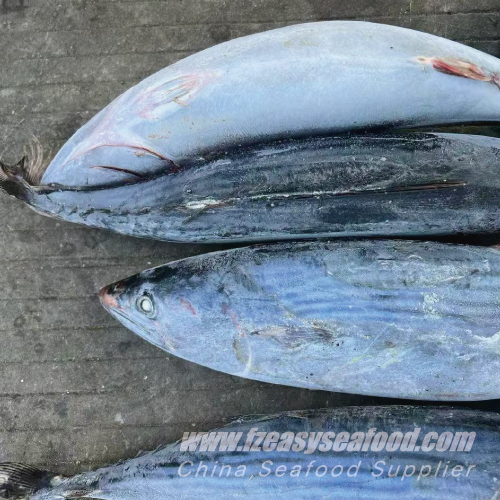
Oriental Bonito (Sarda orientalis, Wild-Caught) — Easyseafood
Oriental Bonito in this product refers to the fish Sarda orientalis (oriental bonito, striped bonito) — a wild-caught pelagic scombrid of the family Scombridae, genus Sarda — supplied whole round (WR) or headed & gutted (H&G), frozen. It is a species identity, not a cut. It is not the "bonito" of canning and katsuobushi — that is skipjack Katsuwonus pelamis, a different genus (and a different HS code). It is also distinct from the true tunas of the genus Thunnus. Locking the Latin name Sarda orientalis prevents substitution with skipjack or off-species tunas.
What It Is
Sarda orientalis is a schooling, oceanodromous pelagic scombrid (mackerel / tuna family) widely distributed across the Indo-Pacific — from the Red Sea and East Africa to Hawaii and the eastern Pacific, north to Japan and south to Australia. It is wild-caught by purse seine, trawl and troll line, chilled at sea, then frozen whole round or H&G by BQF block or IQF with a protective glaze. The flesh is moderate in fat, reddish and firm, valued raw as sashimi (top-grade lots) and cooked by grilling, frying and baking; it is also a canning and drying fish. Maximum size around 1 m, though market fish are commonly ~50 cm.
Key Features
- Wild Sarda orientalis — oriental / striped bonito, catalog default species (genus Sarda, family Scombridae)
- Wild-caught — purse seine / trawl / troll line (not farmed)
- Whole round (WR) or headed & gutted (H&G)
- BQF block (typically 10 kg) or IQF single-frozen
- Protective ice glaze 0–20% optional
- Moderate-fat, firm reddish flesh; sashimi / grill / can / dry grades
Applications
- Sashimi / raw — top-grade fresh-frozen lots
- Grilling, pan-frying, baking — firm steaks and loins
- Canning — a scombrid alternative to skipjack
- Drying / salt-curing — dried-bonito (katsuobushi-style) processing
- Loin & steak — foodservice portions
Certifications & Packaging
- MSC — applicable (wild-capture; certified fisheries available on request)
- ASC / BAP / GLOBALG.A.P. — NOT applicable (oriental bonito is wild, not farmed)
- HACCP / BRC / IFS / ISO 22000 — food-safety management systems
- HALAL / KOSHER — available on request
Storage & Handling
- Frozen at -18 °C or below. Typical shelf life 12–18 months (whole round / H&G, glazed) under an unbroken cold chain. Thaw under refrigeration; for raw use, source sashimi-grade lots and consume promptly. Keep the glaze intact until use to limit oxidation of the reddish muscle.
FAQ
Q1. What species is "oriental bonito"?
A. Sarda orientalis (oriental / striped bonito), family Scombridae, genus Sarda. It is not skipjack Katsuwonus pelamis — the "bonito" of canning and dried bonito — which is a different genus. It is also distinct from the true tunas (Thunnus). Specifying the Latin name prevents substitution with skipjack or cheaper off-species tunas.
Q2. Is it wild-caught or farmed?
A. Wild-caught — oriental bonito is captured by purse seine, trawl and troll line; it is not an aquaculture species. Capture method is stated explicitly so buyers with bycatch / fisheries-management policies can assess it, rather than implying a farmed origin.
Q3. Which sustainability certification applies?
A. Because oriental bonito is wild-caught, the relevant label is MSC (certified fisheries available on request). ASC / BAP / GLOBALG.A.P. do not apply — those are aquaculture standards and this species is not farmed. HACCP / BRC / IFS / ISO 22000 and HALAL / KOSHER are standard regardless.
Q4. What HS code applies to frozen oriental bonito?
A. HS 0303.59 — frozen "other fish" of the pelagic group, which explicitly includes bonitos (Sarda spp.). Do not use 0303.43 — that is skipjack / stripe-bellied bonito (Katsuwonus pelamis), a different genus and code. Some older references list 0303.89; the current HS places Sarda bonitos in 0303.59 — confirm the destination national sub-line with your broker. If filleted, the code shifts to 0304; if canned or prepared, to Chapter 16 — 1604.
Q5. BQF or IQF, and what about glaze?
A. BQF 10 kg block is the bulk standard for whole / H&G oriental bonito (lowest cost). IQF keeps fish separate for retail and portion packs but costs more. A protective glaze (0–20%) limits freezer burn and surface oxidation of the reddish flesh; confirm glaze % at order.
Built On 20 Years of Trust

Established in 2007, our Fujian-based operationspans the full seafood supply chain. Two decadesof navigating global markets means we anticipatechallenges before they reach your door.
2o-Years Industry Foundation
Core markets across EU, North America,
Southeast Asia, and Australia. We handle exportdocumentation, customs clearance, and multi-country compliance -so you deal with onepartner, not five.
Global Market Coverage
Cut size, packaging format, labeling, private label— built to your market's requirements. From500g retail vacuum bags to 20kg industrial bulkcartons, one call changes the spec.
Flexible OEM & Custom Solutions
No seasonal gaps, no supply surprises. Ourprocurement network and cold-storage capacityensure consistent product availability —- thefoundation of any long-term wholesalepartnership.
Year-Round Inventory Stability
Frequently asked questions






View other products
CONTACT US
Phone
086 591 87529356
Address
RM05, 21st Floor, Rongqiao Plaza, No.100 West Jiangbin Avenue, Taijiang District, Fuzhou City, Fujian Province, China
SEND INQUIRY
For the convenience of communication, please make sure to provide the correct contact information.
LEAVE A MESSAGE
For the convenience of communication, please make sure to provide the correct contact information.
CONTACT US
Phone
086 591 87529356
Address
RM05, 21st Floor, Rongqiao Plaza, No.100 West Jiangbin Avenue, Taijiang District, Fuzhou City, Fujian Province, China